
What is an occupational health assessment?
When someone returns to work after an illness, surgery or pregnancy, how can you be confident they're ready to work safely? That's exactly the role of an occupational health assessment.
It's a confidential assessment, carried out by an occupational health professional, that looks at two sides of the same question: how an employee's health might affect their ability to work safely, and how their work might affect their health. The findings help employers make informed decisions about fitness for work, workplace adjustments, return-to-work planning and ongoing support.
.jpg)
It's worth being clear about what these assessments aren't. They don't diagnose medical conditions, and they're not a substitute for advice from a doctor. What they do offer is practical, workplace-focused recommendations, the kind that help you build a safer working environment while giving employees what they need to perform their role effectively.
Used well, an occupational health assessment becomes more than a box-ticking exercise. It helps employers understand where support may be needed before health-related issues become safety issues.
In brief, an occupational health assessment can help employers:
- Determine whether an employee is fit for work
- Identify reasonable workplace adjustments
- Support employees returning after illness or injury
- Understand how physical or mental health may affect safe performance
- Reduce workplace risk by making informed decisions
But there's one important limitation: an assessment only captures a moment in time. Someone might be perfectly fit to return to work today, but that doesn't guarantee every shift ahead will carry the same level of risk. Health is only one part of a much bigger picture. The conditions people experience while they work, from fatigue and time pressure to routine and distraction, also influence how safely they perform their job.
That's why many organisations don't stop at the occupational health assessment. They pair it with an approach built around the day-to-day realities of the job, rather than a single point-in-time review.
What happens during an occupational health assessment?
If you've never been involved in one before, it's natural to wonder what actually happens behind the scenes. The exact process varies between organisations, but most occupational health assessments follow the same pattern.
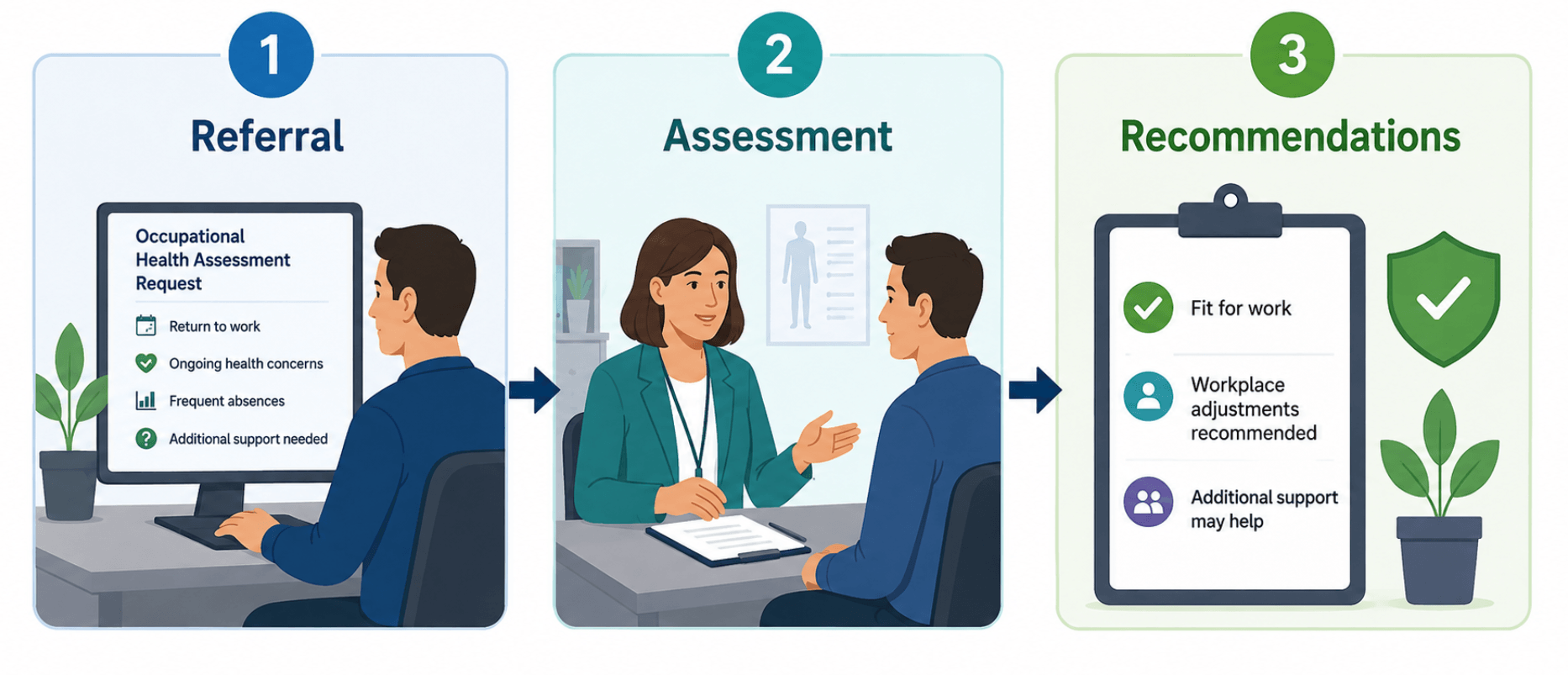
- Referral. An employer requests an assessment because of a return to work, ongoing health concerns, frequent absences or another situation where additional support may be needed.
- Assessment. An occupational health professional discusses the employee's health, their role and any challenges that could affect their ability to work safely.
- Recommendations. The employer receives practical guidance, such as whether the employee is fit for work, whether workplace adjustments are recommended or whether additional support may help.
Throughout the process, the focus is on helping employees work safely, not on diagnosing medical conditions or assigning blame.
The assessment is only the starting point
An occupational health assessment tells you where support may be needed. What it can't tell you is how that person's risk will look next week, or next shift. For that, it helps to know when an assessment is worth requesting in the first place.
When should employers request an occupational health assessment?
There isn't a single situation where an occupational health assessment is appropriate. In fact, it can be valuable whenever an employee's health and their ability to work safely may be influencing each other. Some of the most common situations include:
- Returning to work after an illness, injury or surgery.
- Returning from maternity leave or after pregnancy, where workplace adjustments may be appropriate.
- Frequent or long-term sickness absence.
- Concerns about whether someone is fit to carry out their role safely.
- Changes in job duties or work demands.
- Ongoing stress, fatigue or mental health concerns.
- Safety-critical roles where health may affect decision-making or performance.
- Requests for workplace adjustments or additional support.
The purpose isn't to decide whether someone should or shouldn't be working. It's to understand what support will help them work safely and effectively.
Looking beyond the assessment
Many organisations focus on helping employees return to work safely, which is exactly where occupational health assessments provide enormous value. But returning to work doesn't always mean someone is performing at their best.
Research into dysfunctional presenteeism, where employees are at work but their health affects their performance, found that the onset of poor mental health increased the likelihood of reduced work performance by 12 percentage points, while the onset of a physical health condition increased it by 7 percentage points.
In other words, someone may be medically fit for work while still facing conditions that influence attention, judgement and decision-making throughout the working day.

This is why an occupational health assessment is only the beginning. Understanding someone's health is important, but so is recognising how changing conditions during the working day can influence the decisions they make.
Why human factors matter
An occupational health assessment helps employers understand whether someone's health may affect their ability to work safely. But here's the thing: even when two employees are equally fit for work, they won't necessarily face the same level of risk on any given day.
Safe performance was never just about health. It's also shaped by the conditions we're working under in the moment. Get someone fatigued, and their concentration starts to slip. Get them rushing, and shortcuts start to look reasonable. Frustration narrows what we pay attention to, and complacency has a way of making a familiar task feel far less risky than it actually is.
None of this means someone is incapable of doing their job. It means our ability to spot hazards and make good calls isn't fixed. It shifts, especially under pressure, and it can shift within a single shift, not just from one day to the next.
That's where human factors come in. They don't replace occupational health assessments, they work alongside them, helping people notice when their own risk is climbing before it turns into a critical error or an incident.
Helping people make safer decisions every day
Safety doesn't stop once an assessment is complete. Every day, conditions change. A deadline tightens. Fatigue creeps in. A familiar task starts to feel like it doesn't need full attention anymore. It's in these ordinary moments that the decisions get made that decide whether someone goes home safely.
SafeStart doesn't replace occupational health assessments. It works alongside them, helping people recognise when rushing, frustration, fatigue or complacency start to shape their judgement, before a critical error becomes an incident.
The goal was never just to get someone back to work. It's to help them go home safe, healthy and ready to enjoy life beyond work, every day they're there.
→ Book a personalised SafeStart demonstration
%20(1).jpg)
Published on 06.08.2026
.jpg)

%20(1).jpg)