















What Is Health and Safety in a Warehouse?
Warehouse health and safety means managing risks across systems, environments, and people. Core elements include:
- Identifying warehouse hazards (forklifts, slips, manual handling, falling items)
- Risk assessments and controls
- Safe systems of work, clear signage, and good housekeeping
- PPE selection and use
Even well-designed systems cannot prevent every incident. Because safety does not live only in procedures. It lives in how people perform within them.
What Training Is Needed for a Warehouse?
Typical warehouse training includes:
- Warehouse safety induction
- Manual/mechanical handling
- Slips, trips and falls prevention
- Working at height
- Forklift and MHE safety
- Fire safety and emergency response
- COSHH and hazardous substances
- PPE training
- RIDDOR and incident reporting
- Behaviour-based safety
SafeStart complements these by helping workers apply what they’ve learned—even when under pressure or fatigued. Training only reduces risk when it changes what people actually do...
Common Warehouse Hazards and the Biggest Safety Issues
What are 5 common warehouse hazards?
Every warehouse operation faces safety risks. Some are obvious. Others become dangerous because of the pace and repetition of the environment. Here are the 5 most common hazards:
1/ Forklift and vehicle incidents:
Forklifts are responsible for more serious warehouse injuries than any other vehicle. Globally, forklift-related incidents account for approximately 25% of all warehouse injuries. The loading dock, where forklifts operate frequently, is involved in 1 in 4 warehouse accidents, making it one of the highest-risk zones.(source).
2/ Slips, trips and falls
Still one of the most frequent incident types. Often caused by spills, uneven floors, cluttered aisles, or poor housekeeping. They account for more than 27% of non-fatal warehouse injuries. (source)
3/ Manual handling and musculoskeletal injuries
Strains and sprains from lifting, twisting, or pushing heavy or awkward loads, especially when training or team lifting practices are lacking.
4/ Falling objects and racking failures
Unstable pallets, overloaded shelves, and improper stacking can lead to serious injuries from above.
5/ Work at height
Activities involving ladders, mezzanines, or elevated equipment introduce fall risks without proper procedures and fall protection.
Other factors such as lighting, visibility, temperature, and congestion can increase exposure to all of the above. But listing hazards only tells part of the story...
What is the biggest warehouse safety issue?
In many warehouses, the greatest risk is not a missing procedure. It is what happens after tasks become routine. Warehouses are high-repetition environments. The same routes are driven. The same racks are accessed. The same loads are lifted.
Over time, familiarity changes perception.
What once felt hazardous starts to feel normal. That shift is complacency.
Complacency doesn’t mean someone doesn’t care. It means the task no longer triggers the same level of attention. Add time pressure, fatigue, or frustration, and awareness narrows further.
That’s when:
- Eyes drift off task
- Minds wander
- People step into line-of-fire zones
- Balance, traction, or grip are misjudged
In other words, human error is rarely random. It follows patterns.
SafeStart helps workers recognise these patterns in real time — especially when rushing, fatigued, frustrated, or overly comfortable with a task — and apply practical techniques before a routine job becomes a serious injury. This approach consistently reduces injuries in high-repetition, high-pressure warehouse environments.
Why Traditional Warehouse Safety Training Isn’t Enough
Most traditional warehouse safety training increases knowledge. It explains hazards, procedures, and rules. But knowledge alone does not prevent incidents. Because incidents rarely happen when people don’t know the rules. They happen when people are not fully present in the moment.
In busy warehouse environments, workers face constant operational pressure. Errors typically occur when people are:
- Rushing to meet deadlines or clear backlogs
- Fatigued from long shifts or night work
- Frustrated by delays, equipment issues, or workflow problems
- Complacent with repetitive, familiar tasks
These human states reduce awareness. Eyes drift off task. Minds wander. Shortcuts feel justified, PPE gets skipped. And a routine task becomes a serious injury. Traditional training cannot control these moments.
PPE in Warehouses: Protection That Only Works When People Do
Modern PPE is better than ever. It's more comfortable, better designed, and more protective than in the past. Yet injuries still happen. And often, PPE is not being worn when it matters most.
According to industry research, 98% of safety professionals have observed workers not wearing PPE when they should have (source), with nearly a third saying it happens regularly .
This highlights a hard truth. Providing high-quality PPE is essential, but it is not a guarantee of protection.
In warehouse environments, where tasks are repetitive, time pressure is high, and conditions change quickly, PPE failures are rarely about the equipment itself.
Common Types of PPE Used in Warehouses
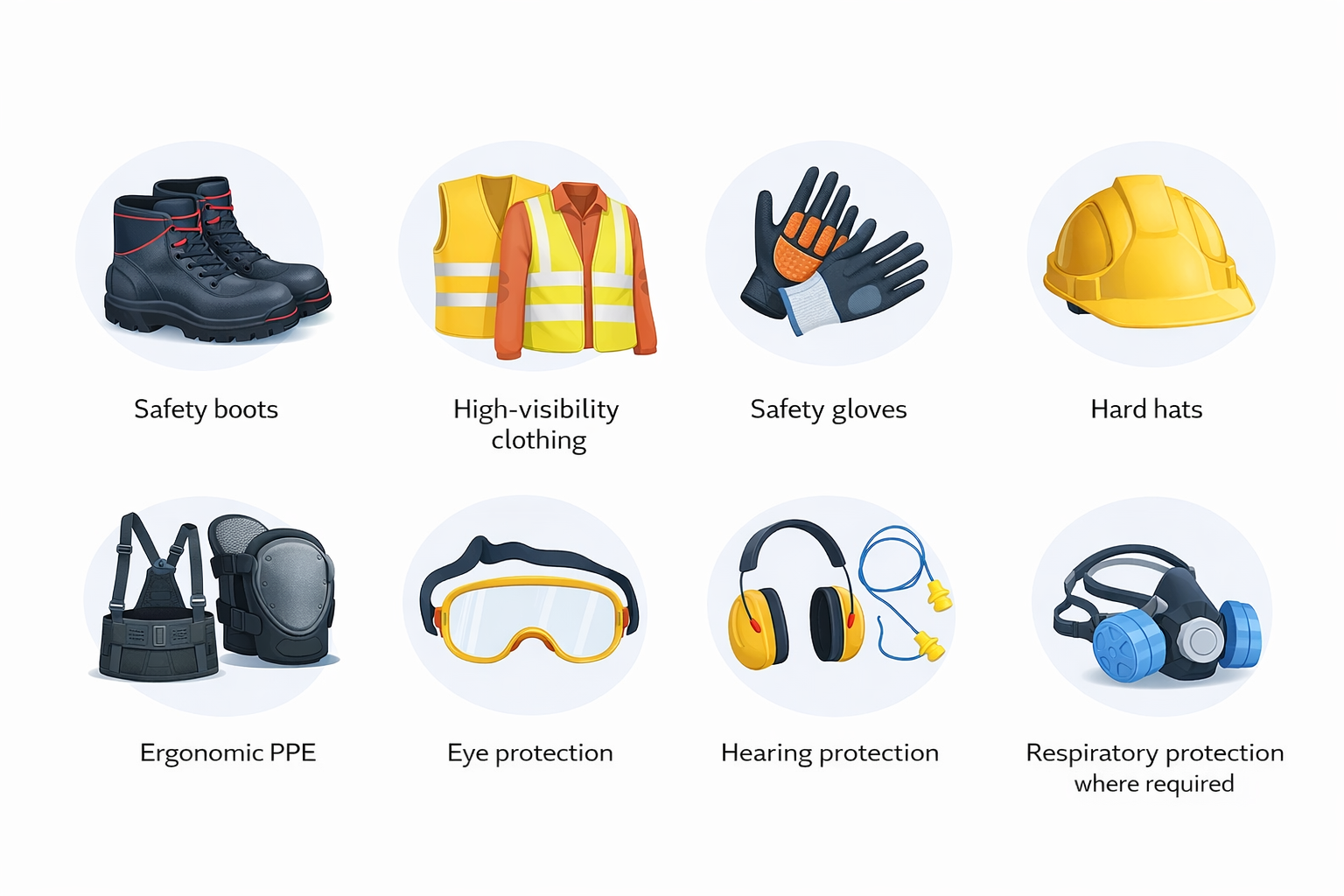
Warehouse PPE typically includes:
- Safety footwear with toe protection: Protects against dropped loads and pallet impacts, with slip-resistant soles for traction on smooth floors.
- High-visibility clothing Helps forklift operators and pedestrians see each other clearly in busy areas.
- Safety gloves: Protect against cuts, abrasions, and sharp edges while maintaining grip and dexterity.
- Hard hats: Protect against falling objects and overhead hazards.
- Eye protection: Shields against dust, debris, splashes, and flying particles.
- Hearing protection: Reduces exposure to sustained noise from machinery and vehicles.
- Respiratory protection (where required): Used when airborne dust, fumes, or chemicals are present.
- Fall protection equipment: Harnesses, lanyards, and anchor systems for working at height.
- Ergonomic PPE: Anti-fatigue insoles, knee pads, anti-vibration gloves, and supportive gear designed to reduce strain and repetitive stress injuries.
Because PPE protects the body. It does not protect decision-making. We’ve created a short, practical guide that explains why providing the best PPE is no guarantee of protection and what actually improves compliance.
[Download the free guide: “Providing the Best PPE Is No Guarantee”]
How SafeStart Strengthens Warehouse Safety Training
This is the gap most warehouse safety programmes miss. If you already have solid systems, but incident rates have plateaued, SafeStart can help you break through. SafeStart works alongside your existing programme. It doesn’t replace your procedures, it adds a missing layer: real-time behavioural awareness.
We help workers:
- Recognise risky states like rushing and fatigue
- Avoid critical errors
- Build skills and habits that stick
- Extend safety mindset from work to home
Used by over 3,500 companies globally, SafeStart consistently delivers:
- 30–50% fewer injuries in the first years
- Reduced downtime and disruption
- Stronger, more engaged safety cultures
That’s the difference between compliance-based training and behaviour-based performance. Because injuries don’t stop at the warehouse gate. SafeStart builds safety awareness that lasts 24/7.
We’ve seen fantastic results… 80% fewer lost-time injuries, and over 700 days without one.
—Mike Howells, Logistics Ops Controller, United Biscuits