
%20(1).jpg)
Published on 31.08.2026
Most workplace injuries do not happen because nobody thought about safety. Organisations invest heavily in risk assessments, procedures, training and controls, yet people still get hurt.
In Great Britain, an estimated 680,000 workers sustained a non-fatal workplace injury in 2024/25, according to HSE estimates. Those injuries accounted for around 4.4 million lost working days.
So what are we missing?
Part of the answer lies in human error. Even experienced, well-trained people can make unintended mistakes while carrying out familiar tasks. Knowing the right thing to do does not guarantee that we will get it right every time.
This is where human error reduction training adds another layer to workplace safety. Instead of simply providing more knowledge or more rules, it helps people develop practical skills and habits that reduce the likelihood of everyday errors becoming injuries.
What is human error in workplace safety?
When an investigation identifies "human error", it is easy to hear that as another way of saying somebody was careless. In reality, human error is much broader than that, and treating every workplace mistake as a problem with attitude can stop us from understanding what actually happened.
HSE uses the broader term human failure and distinguishes between slips, lapses, mistakes and violations. A slip happens when someone intends to do the right thing but performs an action incorrectly, such as pressing the wrong control. A lapse involves forgetting or missing something, perhaps because a person was interrupted halfway through a procedure. A mistake is different again because the action goes according to plan, but the plan or decision itself is wrong.
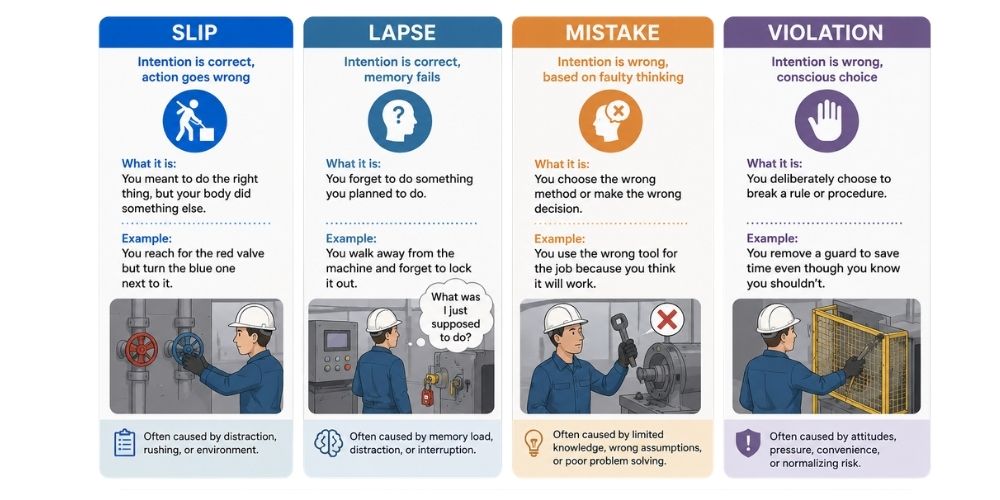
Violations need to be considered separately because they involve a deliberate departure from a rule or procedure.
The distinction matters because slips and lapses can happen to experienced, well-trained and motivated people. Someone can know the procedure inside out and still miss a step when they are tired or distracted. More knowledge is not always the answer when lack of knowledge was never the problem in the first place.
Human error vs negligence
Human error is generally unintentional, while negligence involves a more serious failure to take appropriate care or meet known responsibilities.
An experienced operator might miss a step while rushing, or a driver's attention may drift on a familiar route. Calling either person careless tells us little about why the workplace mistake occurred. A human factors approach asks what influenced performance at that moment and what could reduce the likelihood of it happening again.
Why incident investigations need to go deeper
Larry Wilson explores this idea in an article - Human Error is Not a Cause, It's a Consequence, he argues that "human error" should not be the end of an investigation. Instead, it should lead to another question: what made that error more likely?
His password example makes the point simply. Most of us have entered a password incorrectly even though we know it perfectly well. When we're rushing, tired, frustrated or distracted, mistakes become easier to make. Teaching us the password again would achieve little because knowledge was never the problem.
.jpg)
HSE takes a similar deeper approach through performance influencing factors, including fatigue, workload, time pressure, distraction, communication, procedures and the working environment. Looking at these factors moves incident investigation beyond blame and towards prevention.
How human factors explain workplace incidents
Human factors considers how people interact with their tasks, equipment, environment and colleagues. It recognises that human performance varies, which means the likelihood of error can vary too.
In Paradigm Shifts #1: Hazards or Human Error?, Larry Wilson challenges the idea that controlling hazards tells the whole safety story. Guards, PPE, procedures and engineering controls remain essential, but people can still make errors that bring them into contact with hazards or hazardous energy.
Why rushing, frustration, fatigue and complacency matter
SafeStart focuses on four states that can increase the likelihood of an error: rushing, frustration, fatigue and complacency.

Rushing can lead to missed steps or divided attention, while frustration can make it harder to stay focused on the task. Fatigue can affect attention and judgement, and complacency can develop as a task becomes so familiar that it requires less conscious thought.
These states are normal human experiences. The important point is what can happen next. When someone is rushing, frustrated, fatigued or complacent, they may be more likely to make one or more of the critical errors...
The four critical errors
SafeStart focuses on four critical errors:
- eyes not on task, 👀
- mind not on task, 💭
- moving into or being in the line of fire, ⚠️
- and losing balance, traction or grip. 🦶
The connection between states and errors is important. Someone rushing through a warehouse may stop looking carefully where they are going, which could put them in the path of a moving vehicle. A fatigued worker may lose focus during a familiar task, while someone working in a state of complacency may have their mind elsewhere and fail to notice a change in conditions.
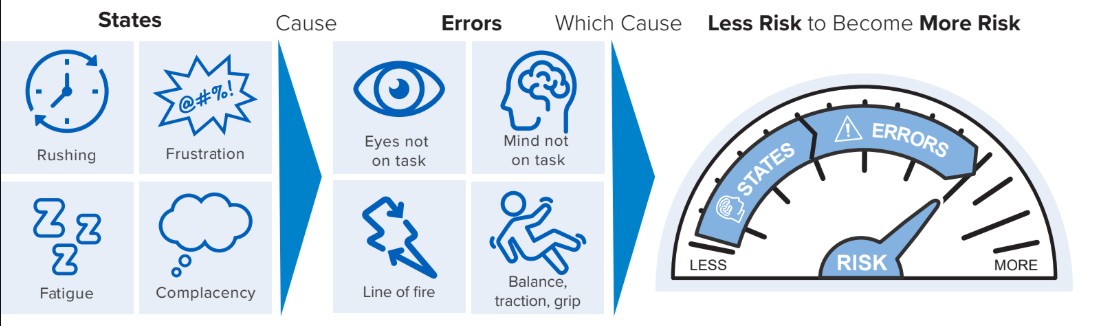
This is the practical idea behind SafeStart's state-to-error pattern. By learning to recognise a state before it contributes to a critical error, people have an opportunity to refocus and reduce their exposure to risk.
Compliance vs human error reduction training
Compliance training remains of course essential because employees need to understand procedures, hazards and safety rules. However, knowing what to do does not mean we will do it correctly every time.
An experienced forklift operator knows to look before reversing. A driver knows to leave enough following distance. Yet rushing, fatigue or complacency can influence what happens in the moment.
Human error reduction training works on this gap between knowing and doing. It complements compliance training by helping people recognise higher-risk states and develop practical responses.
What lasting behavioural change requires
One-off awareness training is unlikely to create lasting change. New safety habits require practice and reinforcement until safer responses become easier to use and automatic responses in everyday situations.
SafeStart's work on the neuroscience behind its Critical Error Reduction Techniques highlights repetition as an important part of developing subconscious safety responses. This means continuing to reinforce the concepts through everyday conversations and practice rather than treating training as a completed event.
How SafeStart addresses the root causes of unintentional errors
SafeStart focuses on what happens before an unintentional error occurs. Employees learn to recognise states such as rushing, frustration, fatigue and complacency, then use practical Critical Error Reduction Techniques to prevent those states from leading to critical errors.
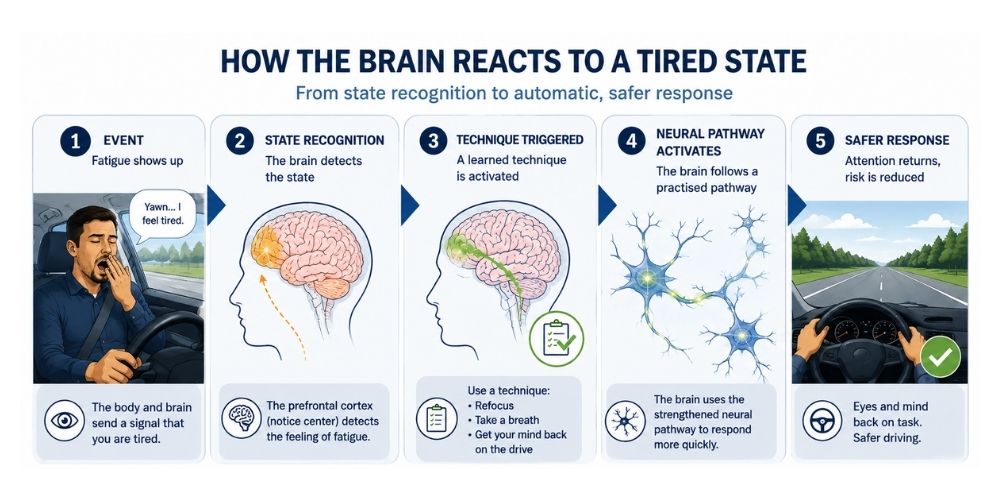
Through repetition, these techniques become stronger habits and help train the subconscious mind. The goal is to build faster, more automatic safety responses, so people can react almost instantly when risk increases.
Take fatigue while driving. A tired driver may yawn or notice their concentration slipping. With practice, that feeling of fatigue can become a trigger to refocus before their eyes or mind drift from the road. The more this response is practised, the stronger and faster it becomes, helping the brain move from consciously thinking about the technique to responding almost automatically. This is why repetition is such an important part of SafeStart training.
What results can organisations realistically expect?
Results depend on leadership support, employee participation, existing safety performance and how consistently training is reinforced.
Organisations fully engaging with the Safestart approach typically achieve 30 to 50% injury reductions within the first 18 months, with reductions of up to 70% reported in some cases.
Progress can also appear through better safety conversations, greater personal risk awareness and stronger engagement with existing safety systems. See our case studies for examples.
Building safer habits around human error
Human error is not simply another name for carelessness, and it should not be the final answer when something goes wrong. The more useful question is what influenced the error and what could make it less likely next time.
Human error reduction training helps people recognise those influences and develop practical ways to respond. SafeStart builds these skills around predictable states and critical errors, helping people develop safer habits while strengthening the safety systems already around them.
Explore SafeStart's human factors safety training programmes to help reduce unintentional errors and build a stronger safety culture.
%20(1).jpg)
%20(1).jpg)