
What Is a Behavioural Safety Culture?
A behavioural safety culture is a workplace culture where employees actively recognise risk, follow safe behaviours consistently, and take responsibility for their own safety and the safety of others.
Traditional safety programmes often focus heavily on procedures, compliance, and hazard controls. Behavioural safety culture focuses on how people behave in real-world situations, especially during pressure, fatigue, distraction, or routine work.
Human behaviour plays a major role in workplace incidents. SafeStart addresses this challenge by helping employees recognise the states and critical errors that commonly lead to injuries.
A strong behavioural safety culture usually includes:
- regular observation and feedback
- leadership involvement
- employee accountability
- open communication around risk
- continuous reinforcement of safe habits
Behavioural Safety vs Traditional Safety Management
Traditional safety management focuses on procedures, compliance, hazard controls, and risk assessments. These elements are essential and form the foundation of any strong safety programme. But in our experience working with organisations across industries and countries, incidents often still happen during familiar, routine tasks carried out by experienced people.
This is where behavioural safety culture plays an important role.
Behavioural safety focuses on the human factors that influence decisions and actions in real time, especially during moments of rushing, frustration, fatigue, or complacency. These states can affect attention, communication, and judgement, even in well-managed environments.
SafeStart helps organisations strengthen behavioural awareness across teams through practical human factors training and ongoing reinforcement. The aim is to help safer behaviours become part of everyday routines and conversations, rather than relying only on procedures or short-term safety initiatives.
The Core Elements of a Strong Safety Culture
After working with organisations across more than 60 countries and a wide range of industries, SafeStart has seen that strong behavioural safety cultures share several common characteristics. The most successful organisations treat safety culture as an ongoing process shaped by leadership, communication, and daily behaviours rather than compliance alone.
Leadership Commitment
Employees follow the behaviours leaders consistently reinforce. Visible leadership engagement is essential for a successful behavioural safety culture.
- Leadership Commitment: In high-performing organisations, leaders actively reinforce safety through daily conversations, visible participation, and consistent expectations. Employees pay close attention to what leaders prioritise operationally, not just what appears in policies.
- Employee Engagement: Companies achieve stronger engagement when safety training feels practical and personally relevant. Organisations using SafeStart often see better participation because employees apply the concepts not only at work, but also at home and on the road.
- Psychological Safety: Open communication plays a major role in sustainable safety cultures. Employees need to feel comfortable discussing mistakes, near misses, distractions, and operational pressures without fear of blame.
- Accountability: Strong behavioural safety cultures encourage personal responsibility at every level of the organisation. Employees learn to recognise how their own decisions, habits, and behaviours influence risk exposure for themselves and others.
- Continuous Improvement: The organisations that sustain long-term cultural improvement reinforce safety continuously through coaching, observation, feedback, and ongoing communication. Behavioural change develops over time through repetition and consistent reinforcement.
The 4 Cs of Safety Culture Explained
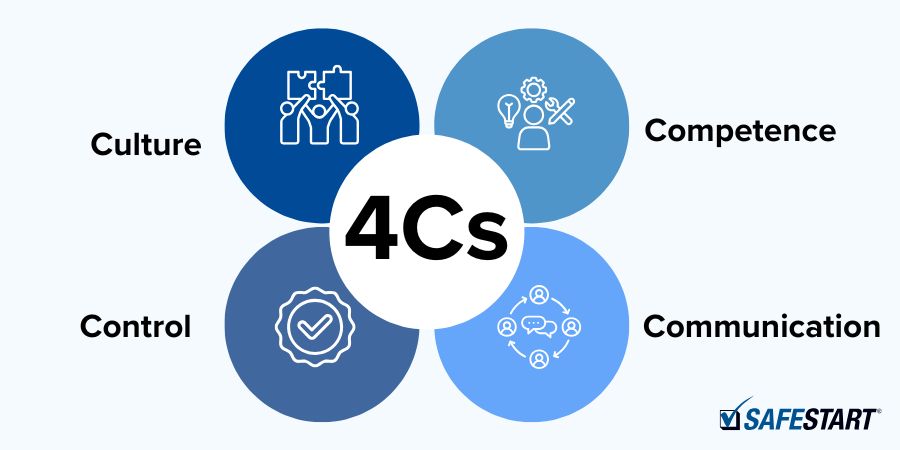
A common framework often used to describe strong safety cultures is the “4 Cs”: Culture, Competence, Commitment, and Communication. Organisations with mature behavioural safety cultures typically demonstrate strength across all four areas because they influence how people think, communicate, and behave around risk every day.
Culture
Culture reflects the everyday behaviours and attitudes employees demonstrate around safety. Strong cultures encourage awareness, accountability, and proactive risk management.
Competence
Employees need both technical knowledge and behavioural skills to work safely under pressure. SafeStart reinforces practical skills such as situational awareness, risk recognition, and decision-making.
Commitment
Safety commitment must exist at every level of the organisation, from leadership to frontline teams. Consistent reinforcement helps turn safety into part of daily operations rather than a short-term initiative.
Communication
Open communication supports stronger behavioural safety cultures. Employees need to feel comfortable discussing risks, near misses, and unsafe situations before incidents occur.
What Is the Golden Rule of Behavioural Safety?
The golden rule of behavioural safety is simple: take personal responsibility for your own safety while actively looking out for others.
Strong behavioural safety cultures depend on employees recognising risk, communicating openly, and intervening early when unsafe situations develop.
Examples of Behavioural Safety in Action
Behavioural safety culture becomes visible through everyday actions and decisions across the workplace.
- A supervisor pauses a task because the team appears rushed near the end of a shift.
- A worker reports a near miss before someone gets injured.
- A forklift operator slows down after recognising fatigue during overtime work.
- A team leader conducts regular safety conversations during walkarounds rather than focusing only on compliance inspections.
Many organisations also implement peer observation programmes where employees reinforce safe behaviours and discuss risk exposure openly. SafeStart strengthens these initiatives by helping employees understand why critical errors happen and how safer habits reduce incidents over time.
Strengthen Your Behavioural Safety Culture With SafeStart
SafeStart helps organisations build a stronger behavioural safety culture by addressing the human factors behind injuries and critical errors.
This is not a one-off training session. SafeStart is a structured behavioural change programme that helps people build lasting safety skills and safer habits for life, at work, at home, and on the road.
The programme focuses on the moments before a mistake happens. Employees learn how rushing, frustration, fatigue, and complacency affect attention, decision-making, and reactions under pressure. Over time, SafeStart reinforces the habits and reflexes that help people recognise risk earlier and respond more safely in real-world situations.
By combining human factors awareness, behavioural reinforcement, and practical daily application, SafeStart helps organisations create long-term improvements in safety culture, employee engagement, and operational performance.
Create a More Sustainable Safety Culture
A strong behavioural safety culture develops through consistent reinforcement, leadership engagement, and everyday behavioural awareness. For more than 30 years, organisations around the world have used SafeStart to help reduce injuries, improve employee engagement, and strengthen human performance across their operations.
Explore how SafeStart can help your organisation build safer habits, reduce critical errors, and create a more proactive safety culture for the long term.
Book a presentation with one of our behavioural safety experts today!