
















The most dangerous moments may be outside normal production
When we think about machinery safety, we often picture equipment running at full speed. But some of the most hazardous moments happen when production stops.
According to the French National Research and Safety Institute (INRS), 60% of machinery-related accidents in France occur during maintenance, cleaning or adjustment rather than normal production. This finding, highlighted in the SafeStart Heavy Equipment Manufacturing Safety infographic, shows why non-routine tasks deserve particular attention.
During these tasks, employees may need to enter areas usually protected by guards, work closer to moving parts or deal with stored energy. Several teams may be involved, while pressure to restart equipment can change how a job is approached.
The most common hazards in heavy equipment manufacturing
Moving machinery and mechanical hazards
Presses, CNC machines, cutting tools, robotic systems and conveyors are part of everyday life in heavy equipment manufacturing. Crushing, entanglement and pinch points are especially important during adjustments, cleaning and troubleshooting.
According to Eurostat accident statistics cited in the SafeStart infographic, loss of control of machinery, tools, vehicles or handling equipment was involved in approximately 27.1% of fatal workplace accidents across the EU in 2023. This figure covers all sectors, not manufacturing alone.
Physical guards, interlocks and safe isolation procedures provide essential protection. They need to be properly maintained and should never be bypassed to speed up production.
Heavy lifting and material handling
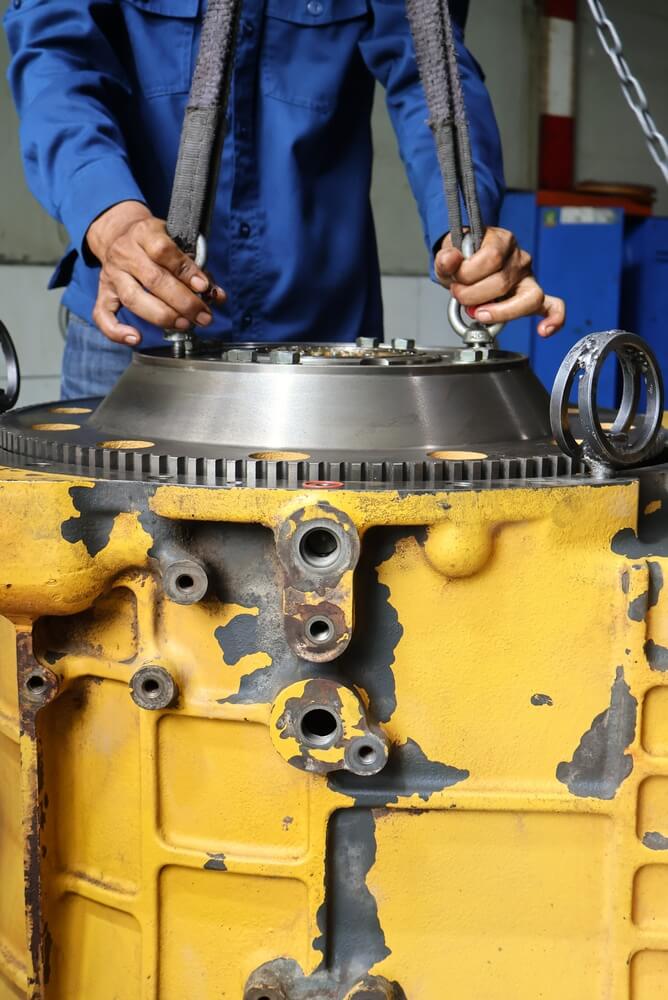
Overhead cranes, hoists and forklifts make it possible to move oversized components, but suspended loads, unexpected movement and restricted visibility create serious risks.
Picture an employee guiding a large metal component into position during assembly. Their attention may be on getting the alignment right, while their hands or body move closer to a crushing point. Lifting plans, exclusion zones and clear communication are essential.
The UK Health and Safety Executive reports that nearly one in four fatal workplace transport accidents in Great Britain occurs during reversing. Keeping pedestrians and vehicles apart and managing blind spots help reduce this risk.
Maintenance and stored energy
Heavy manufacturing industry equipment can hold electrical, hydraulic, pneumatic or mechanical energy even after it has been switched off. A raised component may still fall, or pressure may remain in a system.
Lockout/tagout (LOTO) and equivalent energy isolation procedures help prevent unexpected startup or the release of stored energy. Workers must verify that isolation is effective before work begins.
Welding and metal fabrication
Welding, cutting and grinding expose employees to heat, sparks, noise, metal particles and potentially harmful fumes. Effective extraction, fire prevention and suitable personal protective equipment (PPE) are essential. Repetitive tasks and awkward working positions also deserve attention.
Why experience alone is not enough
Heavy equipment manufacturing relies on skilled fitters, welders, machinists, engineers and maintenance technicians. Technical experience matters, but it cannot remove every hazard.
In a 2024 incident in Great Britain, an experienced fitter was helping move a three-tonne machine using a forklift when the forks dropped unexpectedly. His hand was trapped beneath the machine. The HSE investigation published in 2026 found that the operation had not been properly planned or carried out safely.
This incident shows why technical competence must be backed up by sound planning, effective controls and safe positioning around moving machinery and heavy loads.
How human factors influence workplace injuries
Think about how the same task feels at the start of a shift compared with the end of a long day. The equipment may not have changed, but an employee's concentration, energy and patience can.
SafeStart identifies four critical states that can increase the likelihood of errors:
- Rushing: An operator trying to make up time after a production delay may miss a safety check.
- Frustration: Repeated equipment faults can make it harder to stay focused during troubleshooting.
- Fatigue: Long shifts and physically demanding work can affect concentration and reaction time.
- Complacency: Familiar equipment and routine tasks can gradually receive less attention.
These states can contribute to four critical errors: eyes not on task, mind not on task, moving into or being in the line of fire, and losing balance, traction or grip. Around powerful machinery and suspended loads, the consequences can be particularly serious.
Understanding the conditions behind an incident
When an incident occurs, the immediate problem may be clear: an unexpected movement, someone in the wrong position or a missed check. Understanding why that happened often takes more investigation.
Was the team under pressure to restart production? Had there been repeated interruptions? Did the task change as new problems appeared? Looking at these conditions helps manufacturers improve planning and controls rather than focusing only on an individual mistake.
Building a stronger manufacturing safety programme
Heavy equipment manufacturing companies must follow the safety requirements that apply where they operate. These typically cover machinery safety, risk assessments, hazardous energy, maintenance and worker training.
The hierarchy of controls is a useful starting point. Eliminating hazards, using safer alternatives and applying engineering controls generally provide stronger protection than relying on instructions or PPE alone.
In daily operations, manufacturers should:
- Maintain machinery guards, interlocks and emergency stops.
- Review risk assessments for routine and non-routine work.
- Plan heavy lifts and separate pedestrians from moving vehicles.
- Provide task-specific training and safe energy isolation.
- Involve employees in safety discussions and near-miss reviews.
- Look at how staffing, workloads and production pressure affect risk.
Human factors training adds another layer of protection. It does not replace engineering safeguards or procedures, but helps people recognise when their attention and decisions may be affected by changing conditions.
Helping heavy equipment manufacturing teams build safer habits
Employees cannot always predict an equipment failure or an unexpected change in a routine job. But they can develop habits that help them notice changing risks and respond more effectively.
SafeStart helps employees recognise rushing, frustration, fatigue and complacency and use Critical Error Reduction Techniques (CERTs). Practical training and ongoing reinforcement give supervisors and frontline workers a shared way to discuss human factors in everyday operations.
The goal is to strengthen existing safety systems and help employees build safer habits at work and beyond.
Explore the hidden risks in heavy equipment manufacturing
60% of machinery accidents in France occur during maintenance, cleaning or adjustment. Source: INRS.
Explore industry accident trends, high-risk tasks and the human factors that increase exposure to moving equipment and hazardous energy.
Explore the infographic ↗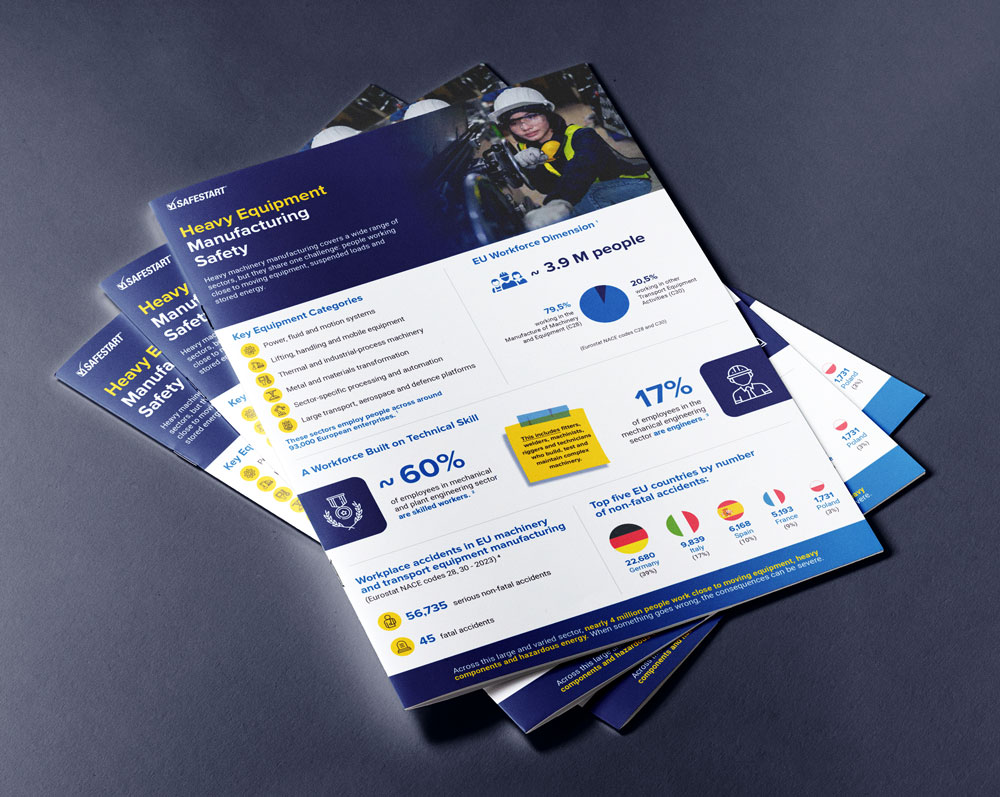
Frequently asked questions about heavy equipment manufacturing safety
What are the safety rules for heavy equipment?
Important practices include proper training, machinery guarding, inspections, hazardous energy isolation, safe lifting procedures and staying clear of moving machinery and suspended loads.
What are the seven basic general industry safety rules?
There is no internationally mandated list of exactly seven rules. Common principles include identifying hazards, following procedures, using safeguards, wearing required PPE, isolating hazardous energy, reporting problems and staying aware of changes.
What are the top 10 safety topics in manufacturing?
Useful topics include machine guarding, energy isolation, lifting, forklift safety, welding, electrical safety, PPE, slips and falls, emergency response and human factors.
What are the 4 Ps of safety?
The 4 Ps are not a universally standardised safety framework. Organisations use different definitions. SafeStart focuses on four critical states: rushing, frustration, fatigue and complacency.
Strengthen safety across your manufacturing operations
Your employees have the technical skills to work with complex machinery. SafeStart helps them develop personal safety skills to recognise changing risks and reduce critical errors alongside the safeguards already in place. Talk to a safety expert.