
HOP (Human and Organizational Performance) starts with a simple idea: people make mistakes. They make them when they’re new to a job, and they still make them after years of experience and training. The useful question is why.
That question has changed the way many organisations think about incidents. Instead of stopping at “the operator made a mistake”, HOP looks at the job, the system and the conditions that influenced what someone did.
But there’s another opportunity for learning. People experience small errors, close calls and changes in their own performance every day, long before an incident investigation or learning team gets involved.

Someone who nearly loses their balance during a familiar task can ask a simple question: “Why this time?” Perhaps they were rushing and their attention shifted. Recognising that connection gives the person information they can use immediately. It can also provide useful information about the conditions surrounding the work.
This gives us two connected levels of learning. Organisations can learn from how work really happens, while people can learn to recognise the states and patterns that affect their own performance.
What does HOP mean and where did it come from?
HOP stands for Human and Organisational Performance. HOP is a philosophy, not a safety programme, training course or set of procedures. It provides a way of thinking about how people perform, how work conditions influence their actions and how organisations respond and learn when things go wrong. Its principles can be applied through the safety processes an organisation already uses, including investigations, risk assessments, learning teams and everyday conversations about work.
HOP has attracted plenty of attention in safety in recent years, which can make it seem new. But many of its foundations have actually been developing for decades through human factors, organisational psychology, systems thinking and operational learning.
Safety practitioner Todd Conklin helped bring the five HOP principles to a wider audience. Today, those principles give organisations a practical way to think about work, error and learning.
The shift from blame to understanding
Blame can bring an investigation to a quick conclusion without explaining much about why an error happened. HOP pushes the investigation further.
If an experienced technician misses a step in a familiar task, the organisation needs to understand what was happening at the time. The procedure may be difficult to use under normal operating conditions, or something about the task may have changed. That information can point to an improvement that helps the next person too.

Accountability means people have responsibilities and organisations have clear standards. Learning means understanding the full picture before deciding what needs to happen next.
HOP in modern EHS
HOP pays close attention to work as it actually happens. Procedures describe how a job should be done, while real work includes changing conditions, interruptions and unexpected problems.
People adapt to those changes every day, and most of the time they do it successfully. Understanding those adaptations can show where a system works well and where workers regularly have to compensate for problems.
People are not the problem to control; people are the solution. - Sidney Dekker
This idea captures an important part of HOP. The people doing the work have knowledge, experience and an ability to adapt that organisations can learn from.
It also raises an important human factors question: What helps people get things right more often when conditions change?
The five core principles of HOP
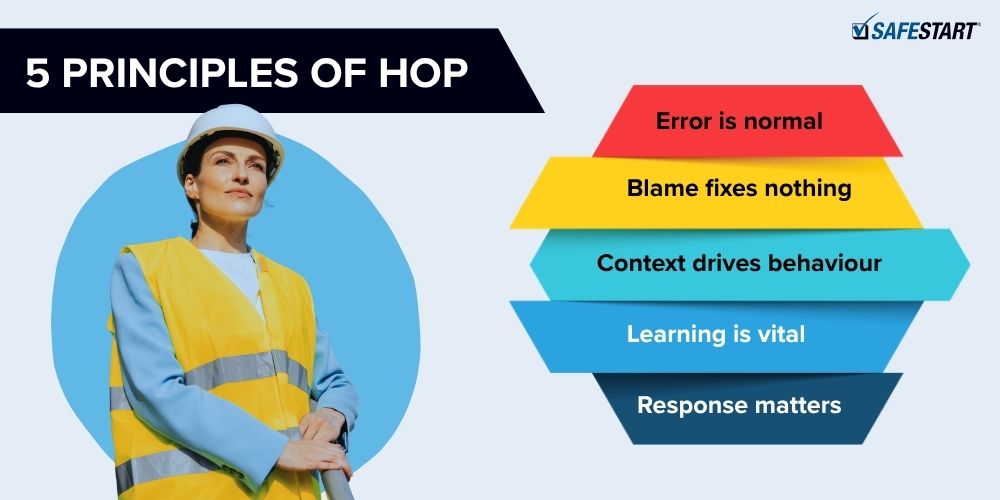
1. Error is normal
Safety is not the absence of errors, it’s the presence of capacity. Todd Conklin
Training, experience and good procedures reduce errors, but people will never perform every task perfectly every time. Work needs to account for human fallibility. If a small lapse can lead to serious harm, organisations should look at how the task and controls can reduce both the chance of an error and its consequences. People can also become better at recognising when their own risk of making an error has increased. That individual awareness complements the controls around them.
2. Blame fixes nothing
Blame tells us who was involved, but it can leave the reasons behind an event unexplored. It can also make people less willing to report mistakes and close calls.
A thing that frontline supervisors need to realise is that people don’t make mistakes on purpose. We know this inherently, but their reaction to errors in the field doesn’t always send that message. So instead of learning how to prevent the next one, people learn how to diminish and deflect- Peter Batrowny President & CEO, PB Global EHS - In Best Vs Worst Engaging the Frontline Supervisor
A learning-focused approach takes time to understand the circumstances. Leaders can then make a better decision about accountability and corrective action.
3. Context drives behaviour
Workload, equipment, staffing, procedures, supervision and production pressure all affect how people work. A person’s state matters too.
A crew that regularly rushes near the end of a shift may be dealing with a scheduling or production issue. The organisation needs to understand that pressure, while workers also benefit from recognising when rushing starts to affect their attention and decisions.
4. Learning is vital
Useful safety information is available long before a serious incident occurs. Normal work, close calls and small errors can all show where conditions are changing or where improvements are needed.
Frontline workers are an important source of that information because they know how tasks work under real operating conditions. And when people understand the human factors that affect their own performance, even a small error can become a learning opportunity.
The question “Why this time?” encourages that type of reflection. Instead of simply carrying on after a close call, the person considers what was different and what they can recognise earlier next time.
5. Response matters
People notice how leaders respond after mistakes. That response affects what employees will be willing to report in the future.
Starting with curiosity gives leaders a better chance of understanding what happened. Clear standards still apply, but decisions about the response can be based on a fuller picture.
Key benefits of applying HOP
HOP can give safety teams better information about how work is actually performed. That can improve corrective actions, reporting and the way organisations use safety systems they already have.
Better prevention
Retraining makes sense when someone lacks knowledge or skill. When the person already knew what to do, the investigation needs to look further.
Finding problems with equipment, procedures or working conditions gives the organisation more options for preventing a repeat. HOP can support better prevention because corrective actions are based on a fuller understanding of what happened.
More open reporting and learning
Close calls can reveal risk before someone gets hurt, but only when people are willing to talk about them.
Workers who see that concerns lead to useful conversations and sensible improvements have more reason to speak up. Over time, those experiences can improve trust and give safety teams a clearer view of operational risk.
How to put HOP into practice
HOP becomes useful when the principles affect what people actually do. Leadership behaviour and frontline involvement are particularly important.
Start with leadership
Employees quickly learn how an organisation really responds to mistakes. Leaders need to listen, make time for learning and act when conversations uncover problems with the work.
The first response after an error matters. Starting with an effort to understand what happened can produce better information and better decisions about what needs to change.
Use learning teams and worker conversations
Learning teams bring together people who understand the work. They can uncover difficulties and everyday adjustments that aren't always visible in procedures or incident reports.
But a learning team can only capture some of what happens during a working day. Conditions change constantly, and people make small decisions and adjustments as they work. That creates an opportunity to take learning one step further.
From organisational learning to individual learning
Larry Wilson, SafeStart’s founder, has described SafeStart’s contribution to HOP as moving “from learning teams to individual learning.”
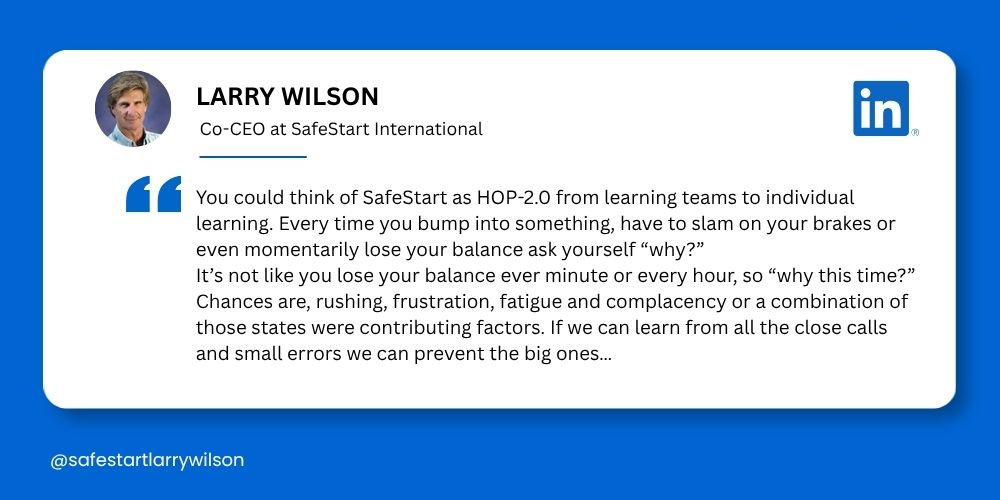
HOP helps organisations understand the context around human performance. SafeStart gives people a practical framework for understanding changes in their own performance as they happen.
There’s science behind this approach. Attention is limited, fatigue affects performance and the brain relies heavily on habits during familiar tasks. These are normal features of human performance, and understanding them helps explain why the same person can perform the same task successfully hundreds of times and still make an error.
SafeStart focuses on four states that can increase the likelihood of critical errors: rushing, frustration, fatigue and complacency. These states can contribute to eyes or mind not being on task, moving into the line of fire, or losing balance, traction or grip.
That learning also feeds back into HOP. Workers who understand the human factors affecting their performance can give supervisors and learning teams better information about what was happening at the time. The organisation can then look for patterns in the work and address the conditions contributing to them.
How SafeStart supports HOP-aligned safety improvement
SafeStart brings these two levels of learning together.
At the organisational level, leaders and safety teams can use what they learn about human performance to improve systems, conditions and controls. At the individual level, people develop skills for recognising the states and patterns that can affect their attention and decisions.
Neither level works in isolation. Better systems give people a better chance of succeeding, while people who understand their own human factors can manage changing risk and contribute better information to organisational learning. This creates more opportunities to learn before a serious event occurs.
Making HOP part of everyday safety
HOP (Human and Organisational Performance) helps organisations look beyond human error and understand why things happen. Its five principles provide a practical framework for thinking about context, learning and leadership response.
The next opportunity is to bring that learning closer to the moment when risk changes. Small errors, close calls and changes in performance happen far more often than formal investigations or learning teams.
When people can recognise what is affecting their own performance, those moments become opportunities to learn too. Combined with organisational learning, that creates a more complete approach to human performance: improve the conditions around people and equip people to respond as conditions change.
Learn more about SafeStart human factors training and how it can support your organisation’s approach to human and organisational performance.

Published on 08.09.2026
.jpg)
.jpg)