
The Moment After a Near Miss
There's a particular moment most safety professionals will recognise. Something goes wrong on site: a near miss, a close call, whatever you want to call it, and for a few seconds, everyone in the room is acutely aware of how differently things could have gone. Then the tension breaks. Someone says, "Good thing nobody got hurt," and the shift moves on. By the next morning, the conversation has usually already faded.
It's an understandable reaction. When there's no injury, it's tempting to treat the event as a lucky break rather than a warning. But that interpretation can quietly obscure what actually happened: in many near misses, the situation wasn't under control. The outcome was just favourable.
That distinction is easy to dismiss, and it probably shouldn't be. Many workplace incidents involve more than procedures or equipment failures. Human factors like fatigue, rushing, distraction, and complacency often shape how people perform under operational pressure.
The (Hidden) Role of Luck in Near Misses
Most safety professionals are familiar with Bird’s accident pyramid, the idea that severe injuries sit above a much larger base of minor incidents, damage accidents, and near misses. It’s a useful model. It helped shift safety thinking away from reacting only to serious outcomes and toward identifying risk earlier.
But the visual also points to something that does not always get enough attention: the same event can move up or down the pyramid depending on timing, positioning, reaction, and something that rarely gets named: luck.
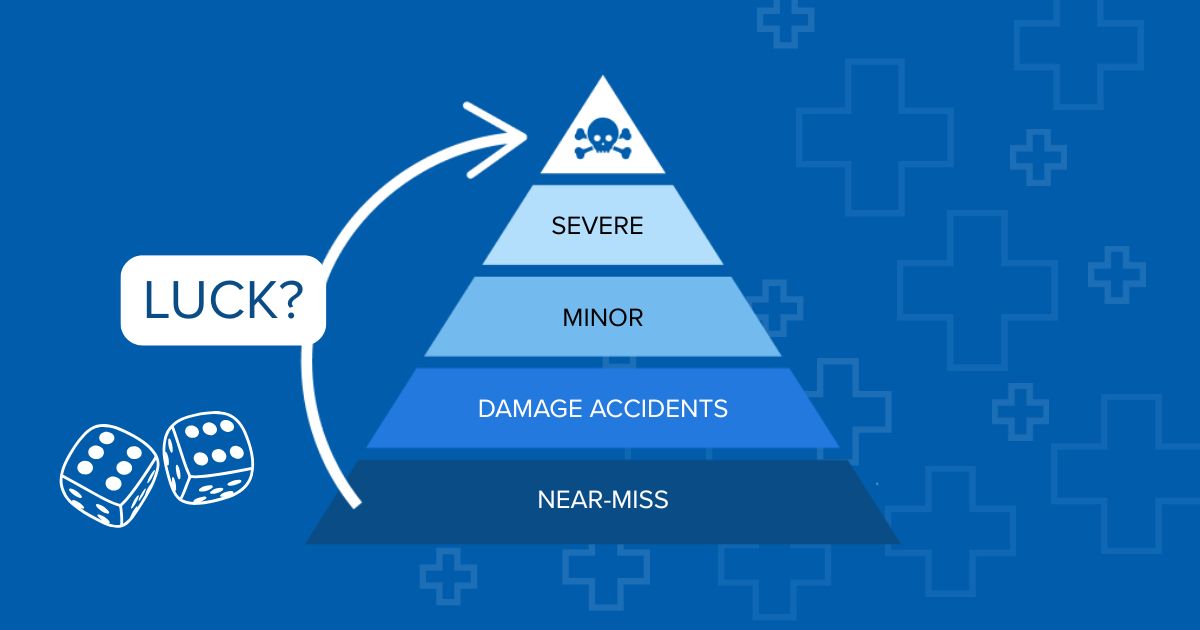
Two workers can make the same mistake under nearly identical conditions and walk away with completely different outcomes. One gets a scare while the other gets seriously hurt. The difference is sometimes a split-second reaction, where someone was standing, how far a load swung, or whether a person caught their balance in time. That is what makes a near miss so important: it is an unplanned event that could have caused injury, damage, or loss, but didn’t.
This is why near miss events are worth taking seriously, not as paperwork to file, but as one of the clearest windows an organisation has into how risk is actually playing out on the ground.
How Familiarity Quietly Erodes Awareness
One of the subtler challenges with near miss incidents is that people naturally judge safety by outcomes. If nothing bad happens repeatedly, a situation starts to feel safe, even when the level of exposure hasn't changed at all.
This is where complacency tends to take root, not suddenly, but gradually.
- An experienced worker moves faster through a familiar task because they've done it hundreds of times without incident.
- A technician under production pressure skips a quick verification step without fully registering the decision.
- Someone finishing a long shift is physically capable of doing the job but mentally a few degrees less sharp than usual.
None of these things automatically cause an incident, which is exactly why they become easy to normalise.
People are remarkably good at adapting to imperfect conditions. They compensate for fatigue, distraction, time pressure, and repetitive routine every day without thinking about it. Operations run smoothly, targets get met, and nothing on the surface looks wrong. But underneath that, the margins for error can be slowly tightening.
This is how organisations sometimes end up relying on luck without realising it. Injury rates stay low, which looks like success, and in many ways, it is. But low injury rates don't always mean low risk. Sometimes they mean the conditions haven't yet aligned in the wrong way.
That's worth sitting with for a moment.
What Near Misses Are Actually Telling You
When a near miss does occur, the most useful conversations aren't just about the physical sequence of events, what failed, which step was skipped, or whether the equipment was in good condition. Those questions matter, but they rarely tell the whole story.
Equally important is what was happening around the person at the time:.
- Were they rushing to finish before a deadline?
- Had a run of demanding shifts started to affect concentration?
- Had the task become so routine that attention had quietly shifted to autopilot?
Human factors like fatigue, rushing, and complacency don't appear suddenly in the seconds before an incident. They build gradually during normal working conditions, which is why organisations that handle safety well tend to focus on reinforcing awareness before anything goes wrong, not just near miss reporting and analysing what happened afterwards.
None of this is about blame. Most people aren't consciously taking risks. More often, they're adapting to the operational realities around them while trying to keep things moving. Understanding that is part of what allows organisations to address the actual conditions driving exposure, rather than just the individual event.
Turning Near Misses Into Safer Habits
A near miss shouldn't simply be viewed as a lucky escape. It should be treated as an opportunity to better understand the human factors and conditions that increase exposure before someone gets hurt.
The goal of safety cannot be to rely on luck alone. Organisations need to help people build the awareness and habits to recognise when rushing, fatigue, frustration, or complacency are starting to affect performance, and know how to react before a critical error occurs.
This is how deeper safety habits are built over time. Not only through procedures and investigations, but through consistent reinforcement that helps safer reactions become part of everyday work.
If your organisation wants to better understand how human factors influence everyday performance and risk, SafeStart can help explore practical ways to strengthen awareness before incidents occur.
Book a presentation with one of our human factors safety experts to continue the conversation.
.jpg)
Published on 28.05.2026
.jpg)
.jpg)