

Summarize this article with:
The conventional view is that pressure to produce within a limited time frame causes an increase in the number and severity of unintentional injuries and incidents. And if your viewpoint is from around 10,000 meters, it certainly appears valid. Plus, if you’re looking for statistics to back up this simple theory, there are plenty to choose from.
So that’s all most people need: a plausible theory and a few statistics and they’re good to go in terms of never really questioning it after that.
However, this theory doesn’t account for the fact that none of us are ever trying to get hurt anywhere, anytime. It also doesn’t include “why” the employee or crew is having to rush in the first place.
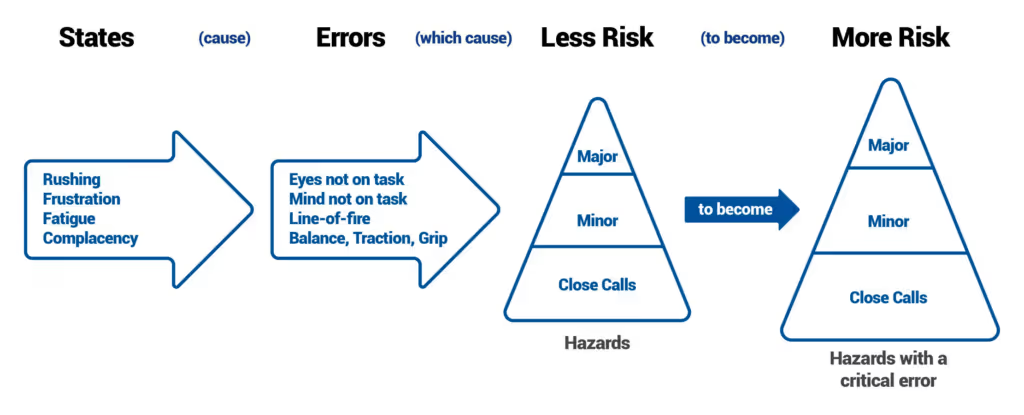
Rushing does cause an increase in mistakes and errors. If some of those errors are critical errors (see Figure #1) then the risk of unintentional injury and incidents will increase. And rushing can easily cause all four critical errors at once because you will likely be thinking about why you’re rushing vs. the risk of what you’re doing at the moment. You might not be moving your eyes around faster so your eyes might not be on all tasks—which could cause you to move into the line-of-fire or lose your balance, traction or grip.
So rushing is a bad state for causing critical errors, which is not to say that frustration, fatigue and complacency are “good” states. But most people in North America and western Europe pick rushing as being their worst states (whereas in Latin America, they tend to pick complacency as being the most problematic).
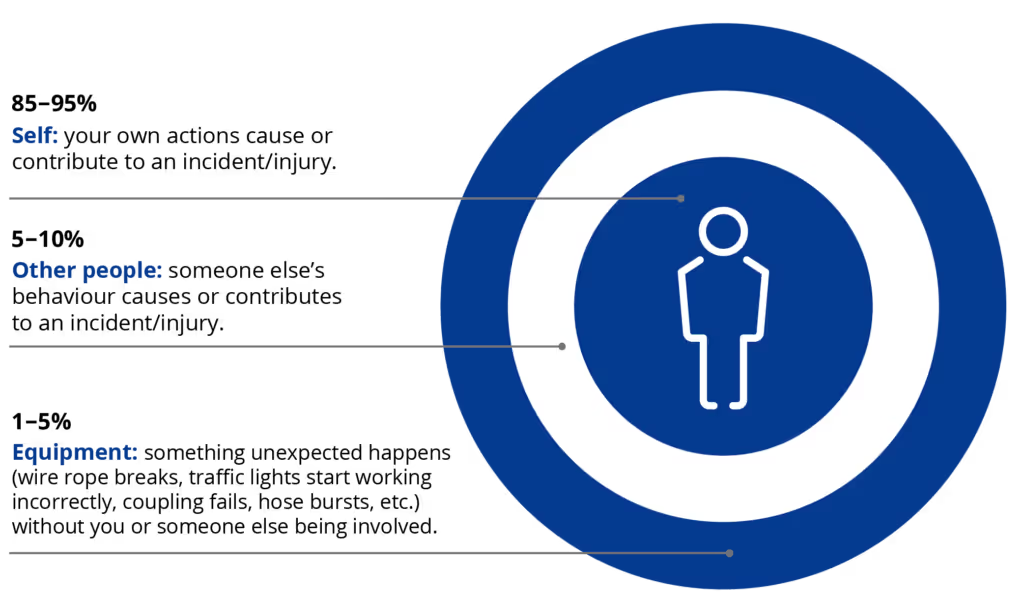
So why do people rush? There are basically three reasons: you do something that makes you rush; someone else does something that makes you rush; or the car, equipment or environment does something that makes you rush (see Figure #1).
Most people freely admit that on a weekly basis, over 90% of the reasons they rush are in the “Self-Area”. In the Self- Area, there are really only two reasons people rush: 1. Poor planning and 2. Making up time for a performance error, like forgetting a tool or the Allen keys so you have to go back to the tool crib, or maybe back to the shop if you were at a construction site. So how often is it really poor planning vs. making up time or trying to make up as much time as you can to minimize the delay? Do you ever plan to rush? Not likely. In fact, most people try to plan so that they don’t have to rush. And yet, most of us find ourselves rushing every day. If you get halfway to work and you realize you forgot your laptop—and you need it—then you have to go back home. Now, you will be rushing. But even if you just get out to the car, and then you remember—you will still be going back to get it faster than when you walked out in the first place. It’s just human nature. We don’t like making mistakes that waste our time so we rush to minimize the wasted time. If other people are waiting and the line is down—and now you (if you’re the maintenance technician) realize that you have forgotten the correct bolts—you will be very inclined to rush, and probably you would even be willing to run back to the tool crib to get the right ones…
And in your rush, you don’t see the piece of paper on the ground as you turn the corner and you slip and fall, breaking your wrist. But you don’t say,
“I was rushing to make up for my error.” You say, “I was rushing for ‘production’.”
And if your error or someone else’s error puts the job behind, because the cement truck was ordered on the wrong day, or it showed up four hours late, then everyone has to rush to get the job done—because nobody puts in an extra 10-20% for screw ups, errors and mistakes. But everybody makes mistakes, every day, and not just one or two. So the likelihood that a big two week turnaround or large construction project is going to happen without any performance errors that waste time is not worth betting on. So, unless you have hired “perfection,” a lot of rushing could be avoided by including a reasonable amount of additional time to make up for the performance errors that will undoubtedly occur.
However, the reality of life in the modern world is that “despite all the improved planning you’re doing” there will still be times when you do have to rush to make a deadline or catch a flight. Perhaps better planning could’ve prevented the situation—but it’s too late for that now. So, can you teach people to rush safely?
Well… as mentioned earlier, rushing or going faster than you’re used to going will likely take your mind off task because you will—most likely—be thinking about why you’re rushing or what will happen if you’re late. Then, if your eyes also go off task, you have a “defenseless moment” and your chances of getting the benefit of your reflexes aren’t very good.
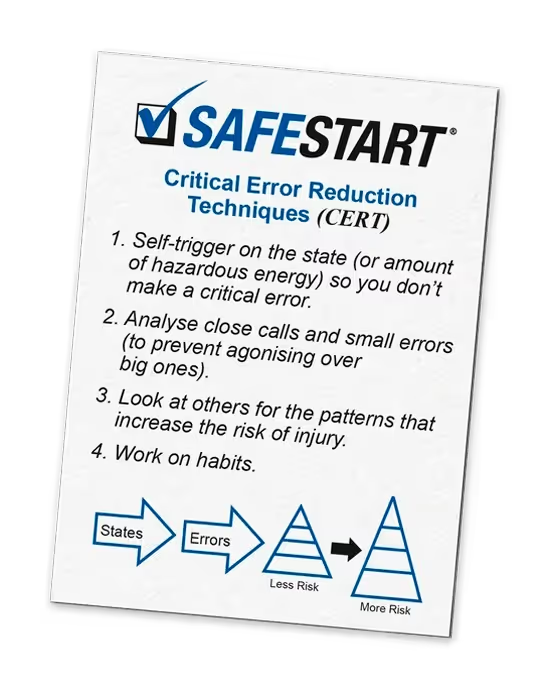
So we have to teach people critical error reduction techniques like “self-triggering” to help them deal with rushing, frustration and fatigue. And we also have to teach them other techniques to help them deal with complacency (see Figure #3).
Self-triggering is basically the skill of recognizing the state quickly and then coming back to the moment—making sure you keep your eyes on task, your mind on task; and that you look for and think about line-of-fire and balance, traction, grip.
In summary, we all know that we need to get down to the “root cause” but far too often rushing is posed as a moral dilemma pitting capitalism against safety, when in reality, in the majority of cases, it’s just ordinary people trying to make up time caused by their mistakes or somebody else’s.
Download this Article
Author :
Larry Wilson
Name
Workload, Time Pressure and Safety – A Different Perspective
File type: