
Summarize this article with:
Safety Culture and Organizational Change
Every company has a culture at the corporate level. In most corporate handbooks, that culture is intended to produce similar cultures at each facility managed by the corporation. But we all know that is not always the case. In practice, every site has a different culture. This can present a number of challenges for corporate-level safety managers who must ensure that an effective safety system is implemented evenly throughout an organization.
Take a look at almost any organization that manages multiple facilities and you will see different levels of safety performance at each site. The culprit is culture. In some cases, a proactive safety culture leads to low injury rates. In others, the serious injury and fatality rate remains frustratingly high year after year.
There are many factors that contribute to the creation of a culture. These include age, gender, education, geography, local influences, and the interaction of countless small factors. As a result, it is nearly impossible to determine exactly which causes are responsible for specific elements of a company’s culture. Culture often develops slowly and can feel as difficult to move as a glacier. It cannot be changed overnight.
To make matters more complex, in the safety world you are not dealing with just one culture. Each employee has their own personal safety culture. Each facility has its own safety culture. The corporate office also has its own culture. These cultures are often in conflict with one another.
Despite these challenges, safety leaders do have one effective option to influence change. Instead of trying to change culture directly, they should focus on developing a workplace climate that takes safety seriously.
There are important differences between an organization’s culture and its climate. Climate can be changed quickly. New safety systems, procedures, or leadership changes can alter the work climate rapidly and effectively. Culture, on the other hand, evolves over time, often over a long period. Those who want to change an organization’s culture should first focus on changing the climate. Over time, culture will follow.
I have spent years studying safety and organizational change. When I speak about cultural change or lead workshops aimed at developing a strong and effective safety culture, much of the discussion focuses on managing difficult organizational change initiatives. This is a major concern for many safety leaders, and there are few simple answers.
One observation stands out. Successful safety initiatives consistently follow established models for organizational change. Too often, safety managers believe their discipline operates under different rules than other corporate functions such as HR or operations. This is not the case. While safety has unique challenges, it is still governed by the same principles that apply to the organization as a whole.
By approaching safety change strategically, it is possible to create a workplace climate that supports long-term improvement in safety culture.
Want to change your company’s safety culture? Forget about culture and focus on change.
By Gary A. Higbee
Managing Complex Change
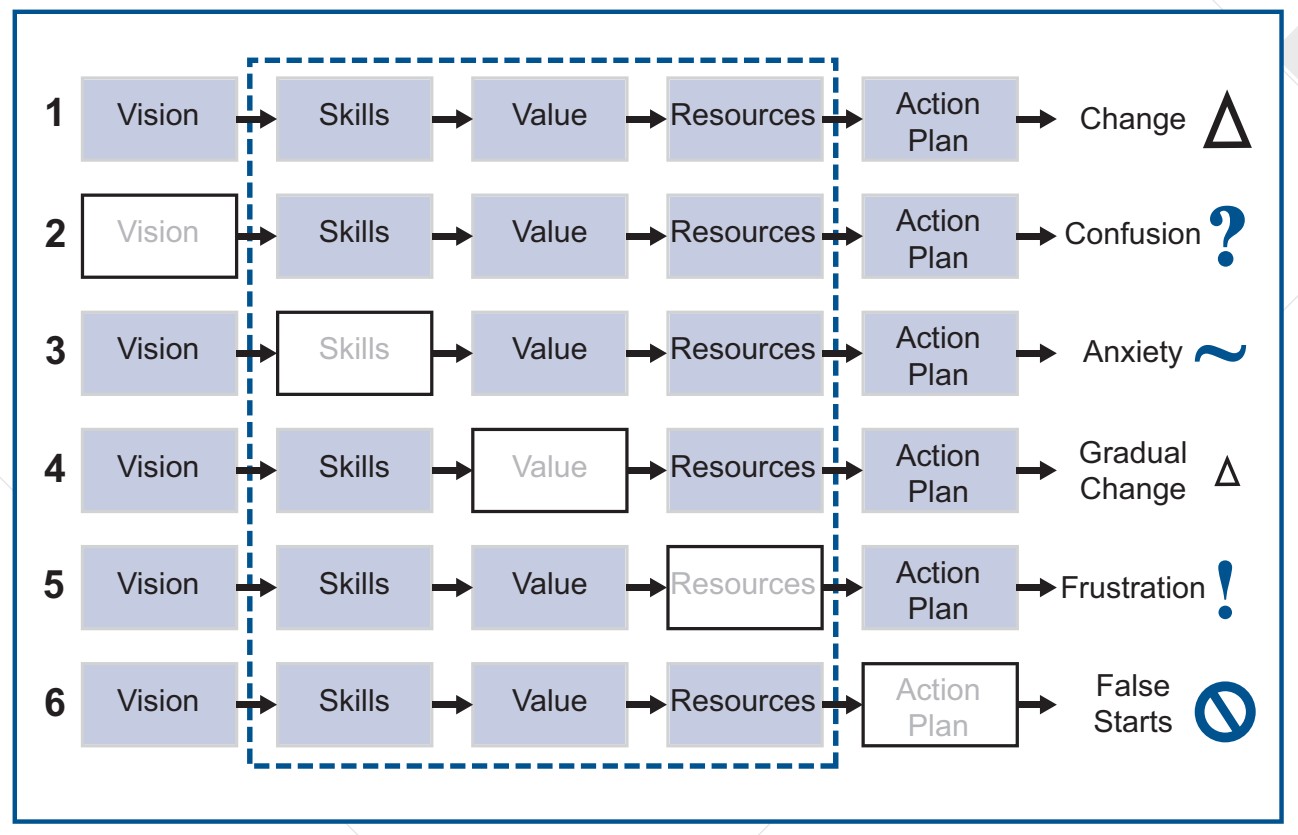
The five essential components are:
- Vision
- Skills
- Value
- Resources
- Action Plan
1/ Vision
Everyone in the organization needs to understand what is being changed and why. They need to know where the organization currently stands and where it is going. Vision often comes from senior leadership, although it can originate at other levels as well.
In safety, the vision should clearly define the ultimate goal and explain how safety fits into the broader organization. Are you striving for zero injuries. Do you want employees to be safer at home as well as at work. The vision should clearly outline the priorities the organization intends to pursue.
2/ Skills
The people responsible for executing the action plan must have the skills required to carry out the work. In safety, this means managers must understand compliance requirements and how human factors influence overall safety performance. Workers should also be trained in both compliance and human factors.
If the required skills are not present, employees must be trained or new personnel must be hired. Many safety improvement plans fail simply because the necessary skills are missing.
3/ Value
Creating value is one of the most important elements in changing a safety culture. Employees often see safety managers as enforcers who tell them what not to do. This can lead to negative perceptions of safety programs.
When workers understand that safety initiatives are designed to empower them by providing skills and resources, rather than controlling behavior, they begin to see safety as valuable. This makes them more open to change.
4/ Resources
Improving safety requires management to commit adequate resources. This includes financial support, equipment, and time for training. Asking employees to perform tasks without proper resources leads to frustration and resentment, which can damage morale and undermine safety efforts.
5/ Action Plan
Once a vision is defined, a clear implementation plan is required. This plan must outline the practical steps needed to achieve the vision and answer a simple question. What do we need to do to get there.
The plan should include input from all affected parts of the organization. Because safety impacts every department, the action plan must apply to all employees. A clear plan acts as a roadmap and helps prevent false starts while keeping everyone aligned.
Putting the Components in Place
Changing workplace climate requires leaders to focus on what they can influence directly. Even one committed executive can positively affect all five components.
Vision and action planning are best developed at the executive level with input from key stakeholders. Budgeting and allocation of time and money are also leadership responsibilities.
Value is the most difficult component to influence because each employee has a different value system. However, most people share similar personal safety goals. They want to stay healthy so they can enjoy life outside of work and support their families. This is why off-the-job and 24/7 safety programs are so effective. Personal safety training helps demonstrate real value and supports long-term cultural change.
All five components are equally important. Leaving one out makes it very difficult to create the desired climate and nearly impossible to achieve lasting cultural change. Vision without action fails. Skills without resources fail. Value without follow-through creates skepticism. When all five components are in place, organizations are positioned for safety success.
Common Roadblocks to Change in Safety

Even when the five components are present, success is not guaranteed. Past failed initiatives often create resistance to new programs. Many workers have seen safety efforts fade over time and assume new ones will do the same.
There are four common roadblocks that often prevent otherwise strong safety initiatives from succeeding.
Overemphasis on Compliance
One major obstacle is the belief that compliance alone leads to better safety performance. Many initiatives focus on meeting regulatory requirements. While compliance reduces legal risk, it does not necessarily reduce injuries.
Regulatory performance and injury reduction are not the same goal. A safety measure only works if it is actually used. For example, installing handrails may satisfy regulations, but if workers do not use them, injuries can still occur.
Production pressure can also encourage risky behaviors such as rushing, which no compliance rule can fully eliminate. The way work is managed can increase the risk of human error. This is why relying on compliance alone is not enough.
Human factors training addresses behaviors such as rushing, fatigue, frustration, and complacency. These risks cannot be controlled by rules alone and must be managed through awareness and skill development.
Status Quo Bias
Many safety programs exist simply because they are familiar. This is known as status quo bias, an emotional preference for keeping things the way they are. Change initiatives challenge existing practices and can expose safety professionals to criticism.
Sticking with the status quo feels safer professionally, but it delivers the same results. If the goal is to significantly reduce injuries, the status quo must be challenged.
Risk Perception
Another challenge is how risk is perceived. Workers often judge incidents by the outcome rather than the potential. A minor injury may seem unworthy of reporting, even though the same event could have resulted in a serious injury.
Safety professionals assess risk based on potential, not outcome. When this difference is not understood, change initiatives face resistance.
Education is the best way to address risk perception. Organizations often explain how a change works, but not why it matters. Explaining the reason behind a change, its benefits, and answering questions helps recalibrate risk perception and reduces resistance.
Not-So-Common Sense
Many people believe safety is simply a matter of common sense. This belief implies that injuries happen due to lack of intelligence. This is misleading.
Common sense varies from person to person based on experience. One worker may believe working slowly is smart, while another may believe speed shows commitment. Safety professionals must help align these beliefs toward safer behavior.
There is also little connection between intelligence and sustained attention. Maintaining awareness over long periods requires stamina, skills, and training. Focus can be strengthened gradually, supported by motivation, and reinforced with techniques to manage human factors such as rushing, fatigue, frustration, and complacency.
Conclusion
These four roadblocks pose serious risks to safety initiatives. To manage change successfully, compliance should be viewed as one tool among many. Organizations must also challenge the status quo, address risk perception, and move beyond the idea that safety depends on common sense alone.
By using the five essential components of organizational change as a roadmap, organizations greatly increase their chances of achieving lasting safety success.
Download this Article
Author :
SafeStart
Name
Safety Culture and Organizational Change
File type: